

2026 is set to mark a decisive inflection point in the AI revolution. ChatGPT was officially launched by OpenAI in November 2022 and for the past three years AI has advanced at extraordinary speed. However, we believe this year represents something different and is likely to be the point at which the AI transformation moves from debate to inevitability.
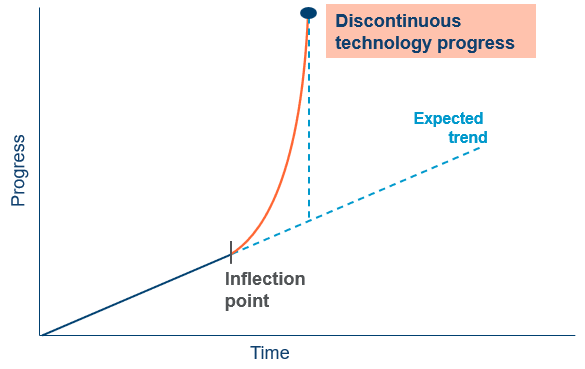
The key to understanding this shift is discontinuous progress.
Most technological cycles evolve incrementally. Capability improves gradually, adoption builds steadily and markets adjust over time. AI is not following that pattern. We are in the midst of a rare period where capability compounds and inflects rather than advances at the margin. Decades of normal technological development are being compressed into years – as we saw with the printing press and its huge structural impact on society, railway construction creating new markets virtually overnight, mass production causing the collapse in production costs and the internet becoming the default layer for information and commerce.
| The nature of discontinuous progress |
 |
| Source: Polar Capital, August 2024. AI Impacts, 13 April 2020, https://aiimpacts.org/discontinuous-progress-in-history-an-update/. |
Once this is understood, recent AI capital expenditure (capex) announcements make far more sense. Rapid advances in model capability, coding automation and capital investment are accelerating enterprise adoption to a scale that will be increasingly difficult for investors to ignore.
This is not a typical cycle.
Discontinuous progress drives inflection
Business adoption of generative AI – that can create new content and ideas including conversations, stories, images, videos and music – is likely to materially accelerate in 2026. Judging by the progress demonstrated by Claude 4.5 and Gemini 3.0 at the end of 2025, coding automation appears to be approaching a structural tipping point. It may not be long before the majority of code is written by AI systems.
Commercial inflection is already visible in the data. Generative AI meets the criteria for one of these rare moments of discontinuity. It is both unpredictable and, in some quarters, still underappreciated. However, enterprise monetisation is scaling at an unprecedented rate.
OpenAI's annual recurring revenue (ARR) was estimated at approximately $10bn in January 2025. By September 2025 it had risen to around $13bn and it surpassed $20bn for the full 2025 calendar year, confirmed in January 20261. That represents roughly 233% year-on-year growth.
We believe this year [2026] represents something different and is likely to be the point at which the AI transformation moves from debate to inevitability
Anthropic entered 2025 with an ARR of approximately $1bn. It accelerated to around $5bn by August, reached $9bn in December and, as of February 2026, has reportedly climbed to $14bn2.
The progression from $10bn to over $20bn ARR at OpenAI, and from $1bn to $14bn at Anthropic within a single year, represents an extraordinary acceleration in businesses monetising AI. It is difficult to find historical parallels at this scale.
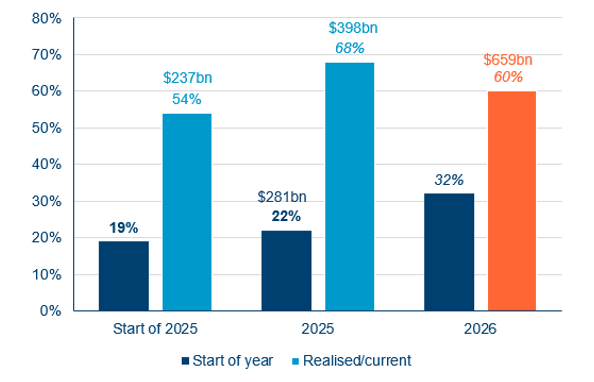
Capital markets are responding accordingly. Press reports suggest OpenAI is close to raising more than $100bn at a valuation that could exceed $850bn3. Anthropic's $30bn Series G funding round in early 2026 valued the company at approximately $380bn4. Such capital intensity reflects conviction that AI capability and demand will continue to expand.
| Consensus estimates for AI / hyperscale capex |
 |
| Source: FactSet, Goldman Sachs Global Investment Research, AI Capex boom, 7 November 2025. Forecasts are based upon subjective estimates and assumptions about circumstances and events that may not yet have taken place and may never do so. |
From debate to inevitability?
We expect AI model performance to continue improving. If that trajectory holds, 2026 is likely to mark a turning point for business adoption. It may prove to be the year when the widespread impact of AI becomes too obvious to ignore, with implications extending well beyond the technology sector.
AI spending today accounts for approximately 1% of global GDP. Historical precedent suggests this could rise to 2-5% at peak intensity, with the investment cycle lasting at least 5-10 years5. If correct, the current phase remains early.
While valuations have expanded, performance over the past three years has largely been fundamentally driven, supported by robust AI capex growth. That stands in contrast to the late 1990s and the Covid period when strong returns were primarily driven by rising share prices and investors being willing to pay higher valuations, rather than by improvements in the underlying strength of the businesses themselves.
Risks remain. If AI model progress were to stall, investment momentum could slow. However, recent advances suggest scaling laws remain intact for now. As with all new technology cycles, volatility should be expected.
The more important point is structural. Discontinuous progress changes behaviour. It changes capital allocation. It changes competitive dynamics.
In our view, 2026 is likely to be remembered as the year that AI ceased to be a topic of discussion and became an inevitability.
1. OpenAI CFO says annualized revenue crosses $20 billion in 2025 | Reuters
2. Anthropic raises $30 billion in Series G funding at $380 billion post-money valuation \ Anthropic
3. OpenAI secures up to $110bn in record funding deal
4. Anthropic raises $30 billion in Series G funding at $380 billion post-money valuation \ Anthropic
5. Goldman Sachs Investment Research, Bureau of Economic Analysis, Global Economics Analyst, The AI spending boom is not too big (Briggs), 15 October 2025